From Chained Codices to Local AI: A History of Intellectual Property Protection
1. Knowledge Was Always in Danger
There is something particularly unsettling about losing a thought rather than an object. The disappearance of a manuscript, research notes, a half-finished study, or a carefully compiled document is not just data loss: it feels as if our own intellectual work is slipping out of our hands.
Perhaps this is why the fate of our documents is such a sensitive point. It hurts not only if a material is destroyed, but also if it falls into unauthorized hands, is copied, misunderstood, taken out of context, or simply used in a way that we no longer control. Knowledge has always been more than mere information: personal time, attention, research, form, and intellectual property are condensed within it.

The protection of intellectual property, therefore, did not begin in the digital age. Long before the internet, the cloud, or AI, the guardians of knowledge were preoccupied with the same question: how can something be made accessible without becoming vulnerable? One of history's recurring patterns is precisely this: every era has tried to protect what it considered most valuable using its own cutting-edge technology.
2. The Age of Physical Protection
Medieval people knew exactly that knowledge is value. The production of a single book could condense months or sometimes years of work: the parchment, the copyist's work, the decoration, the binding, and the text itself represented a value that could not simply be left unattended. This is why the practice of libri catenati, or chained books, developed across Europe, remaining one of the most widespread forms of library protection from the Middle Ages until the 18th century.
The logic of the system was simple and fascinatingly modern. The book was chained to the shelf or reading stand; the chain was long enough for the reader to take down and use the volume on site, but not long enough to take it out of the building. Knowledge was thus not locked away, but accessible in a controlled manner.
This solution was particularly important in an era when books were rare, expensive, and difficult to replace. The chain was not the enemy of knowledge, but its condition: it ensured that the community could use the book without a single person simply stealing it. Protection and access were not opposites here, but two sides of the same system.
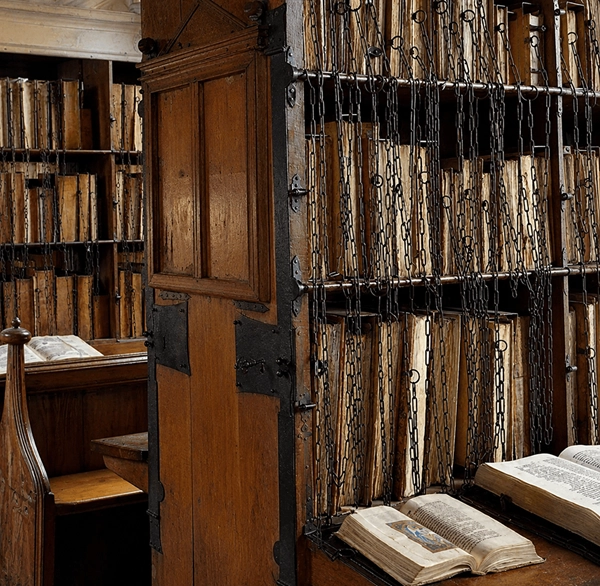
The Hereford chained library is one of the most famous surviving monuments of this logic today. According to sources, it is the largest surviving chained library, and its special significance is that the chains, rods, and locks have survived intact, meaning that not only the idea but the physical security infrastructure itself is visible.
Transition to the present
…And in fact, we want the exact same thing today. We want our work to be readable, processable, and editable — but not vulnerable to being copied, stolen, or brought under the control of a foreign system by anyone. Today, the place of the medieval chain is not taken by iron and padlocks, but by another principle: data should stay where it was created.
In this sense, local processing is not a new invention, but a modern version of an old intuition. The same thought returns: giving access without losing control.
3. The Gutenberg Shock and Pirate Printers
In the age of book chains, stealing knowledge was still a physical act: someone actually had to take the volume. With the advent of printing, however, something fundamentally changed. Gutenberg's invention not only dramatically accelerated the spread of knowledge, but also raised the problem of copying to a new level: the main danger was no longer the theft of the original copy, but its rapid, cheap, and mass reproduction.

This turn of events was both liberating and threatening. The printing press moved knowledge out of the world of monasteries, chapters, and narrow workshops; at the same time, it allowed a successful text to almost immediately fall into the hands of rival workshops. Technology democratized access — and with it, unauthorized copying.
Printers in early modern Europe quickly recognized this danger. Venice in particular became a center for this struggle, where books represented not only cultural but also serious commercial value. Printers and publishers therefore applied for privileges: legal protection that granted an exclusive right to reproduce a work or edition for a specific period. The stake here was no longer merely guarding an object, but controlling reproduction.
Along with this emerged the figure of the early "pirate printer." The actor who did not bear the author's or publisher's investment, but copied an already successful work, cheaper, faster, for their own profit. The problem sounds familiar: whoever creates something bears the burden of time, work, and risk; whoever copies it often avoids exactly this burden.
For a long time, however, the focus of legal protection was not the author, but the printer or publisher. That is why the Statute of Anne in 1710 was a turning point. This law did not simply try to regulate the order of the book trade, but also had a principled significance: it stated that the primary right attached to a work is not merely a matter of publishing monopoly, but the recognition of the author's right.
At this moment, the logic of protection transformed again. In the Middle Ages, the book had to be chained; in the age of printing, the right to copy had to be restricted. The development of technology therefore did not eliminate the old problem, but merely shifted it into a new space: the control of reproduction replaced physical possession.
And perhaps this is where this story becomes truly modern. Because after the printing press, the question was no longer who had access to the original, but who controlled the copy. This question has not disappeared since — only today we ask it again not in a world of lead type, but in a world of digital files, uploads, and algorithmic systems.
4. Industrial Espionage and the "Umbrella" (20th Century)
In the age of printing, the central question of protection was who could copy. By the 20th century, however, the stakes had changed again: it was no longer just books, but technologies, research results, industrial processes, and state secrets that became the focus of protection. Intellectual property was no longer merely a cultural asset, but an economic, military, and geopolitical resource.
In this era, possessing knowledge often meant possessing power. The formula for a new alloy, the production method of a medicine, a military development, or a nuclear research result was not simply "information," but a strategic advantage. The question was no longer who reads the text, or even just who reproduces it, but who can access it at all.
This century became the golden age of access restriction. Security was imagined in physical layers: closed offices, locked cabinets, combination safes, sealed dossiers, guarded archives, and strictly regulated access protocols. Protecting a document was less and less a question of public rights and increasingly one of regulating physical proximity.
The logic of "clearance" also belongs to this world. Not everyone could see everything; knowledge was layered, classified, and structured according to access levels. Protection here no longer consisted of chaining the document or protecting it with legal formulas, but in controlling the path of information from person to person, room to room, briefcase to briefcase.
The Manhattan Project during World War II became the textbook example of how a massive scientific-industrial program could be run so that most participants knew only as much as was absolutely necessary for their own tasks. Los Alamos, Oak Ridge, and Hanford were suitable for this partly precisely because of their geographic isolation; entry was regulated by guards, ID badges, and clearance levels, while most workers operated on a "need-to-know" basis with highly compartmentalized information.
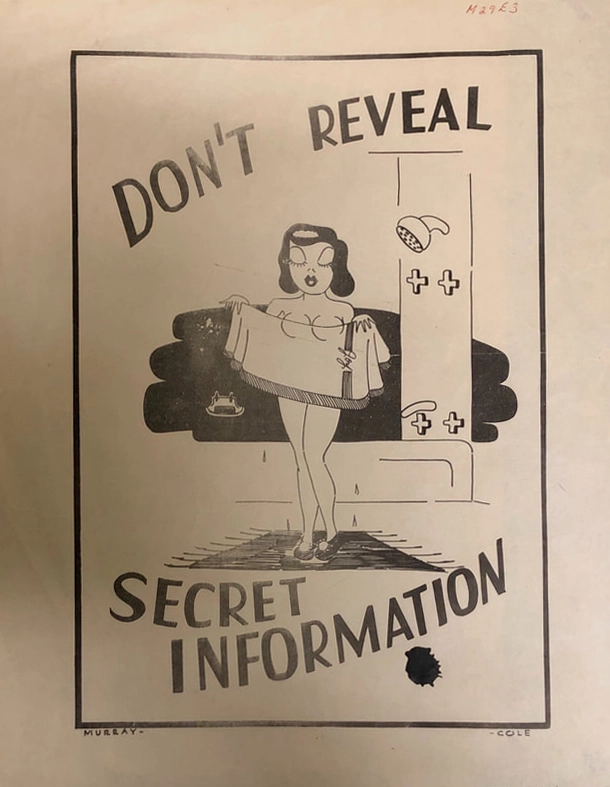
The goal of the system was that even if someone gained access to a detail, they could not easily piece together the full picture. This shows exactly the 20th-century logic discussed in part 4: knowledge is no longer a public object, but a strategic resource circulating in a closed circle.
One of the symbols of the 20th century is therefore not the book chain or the printing press, but the locked briefcase. The object that simultaneously represents mobility and restriction: the document is in motion, but only in designated hands, on a designated route, under designated supervision. It is as if the old chain had disappeared — but in reality, it only became invisible, living on in the form of administrative protocols, entry systems, and encryption levels.
The darker side of the era, of course, was the world of industrial espionage. Because where knowledge is a strategic advantage, someone always appears who wants to circumvent this advantage: the rival state, the competing company, the embedded insider, the leaker. Protection here was no longer directed against simple theft, but against the targeted, conscious, and organized information gathering of the other party.
In this sense, the 20th century rewrote the history of intellectual property protection. The question was no longer how to keep a book, or how to restrict the reprinting of a text, but how to create an environment where knowledge exists only for those who are truly allowed to see it. Protection itself became a system.
And yet: however sophisticated this world was, its logic remained fundamentally the same as that of chained libraries. Knowledge was accessible — but only under controlled conditions. The only difference was that the iron chain was replaced by the key, the seal, the access card, and the authorization list.
5. The Illusion of the Cloud (Early 21st Century)
In the world of the 20th century, protection was still visible. We saw the locked door, the safe, the seal, the access card, the guard at the gate. At the beginning of the digital age, however, a deceptive change occurred: access suddenly became weightless, and with it, the risk became invisible.
The first decades of the 21st century brought a revolution of convenience. We send documents in e-mails, upload PDFs to online converters, edit Word files in browsers, and revise manuscripts on cloud-based interfaces. Everything became faster, simpler, more elegant — and precisely because of this, for a while it seemed that the problem of security had been solved, or at least become secondary.
But this was largely an illusion. The digital document did not become less sensitive, only less tangible. When we upload a file to a "free" service, we often no longer use a tool, but enter a foreign infrastructure whose operation we do not see, whose rules we do not write, and whose boundaries are often defined only by the fine print.
Here the new pain point of the era appears. Because the user mostly feels they are simply transforming a file: extracting text from a PDF, merging several documents, separating pages. In reality, however, in many cases they are not simply using a function, but handing over a document to an external system — sometimes without knowing exactly how long it will stay there, what logging occurs, what third-party infrastructures it passes through, or what other data processing logic is attached to it.

The conflict is therefore not a technical detail, but a breach of trust. The cloud promises convenience, but often comes at the price of control slipping unnoticed from our hands. Not because every service is acting in bad faith, but because the system's basic logic has reversed: what used to happen on our machine, under our direct supervision, now takes place on remote servers, behind terms of service and data management architectures.
In this new situation, the old question returns unchanged. Who has access to the document? Who can copy, analyze, store, transmit, log, or use it for purposes that go beyond our original intention? At the beginning of the digital age, many believed that knowledge was finally completely liberated. In reality, however, often all that happened was that the old chain did not disappear, but became invisible.
And perhaps this makes the present problem particularly acute. The medieval reader saw the chain. The 20th-century researcher saw the safe and the guard. We, on the other hand, often see nothing — only a friendly button, an upload field, a quick result. The loss of control today no longer happens in the form of a dramatic scene, but in the silence of a single click.
6. Return to the Chain: Local Processing (Our Mission)
And here the story connects with the present. Over long centuries, we have asked the same question over and over again: how can knowledge be made usable without making it vulnerable in the process? The answer changed from era to era — chain, privilege, safe, clearance, contractual terms — but the problem itself remained exactly the same throughout.
The uniqueness of our time is that technology finally allows the modern return of an old intuition. It is no longer always necessary for a document to leave its own environment. It is not absolutely necessary to send a PDF to an external server to split pages, merge files, or extract text. What could once only be solved with central infrastructure can today in many cases be done directly in the browser, on the user's own machine.
This is the true significance of local processing. It is not merely a technical convenience, nor a marketing gimmick, but the restoration of a fundamental principle: the document should stay where the trust is. The file should not wander into unknown systems, should not be unnecessarily exposed to external infrastructures, and we should not have to hope retroactively that "surely nothing happened to it."
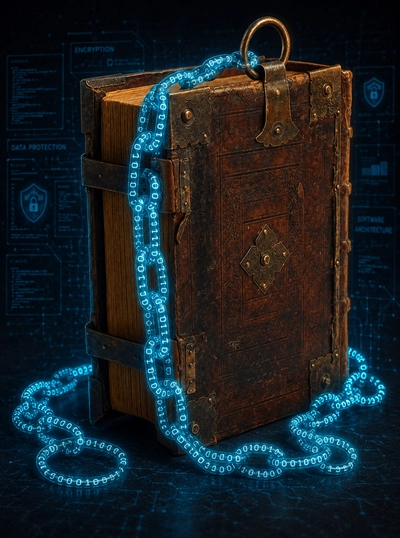
This is why the Secure Academic Studio site was born. Not to create yet another online utility site among many, but to give back to the user the control that has gradually blurred in the era of digital convenience. The goal is simple: the tool should be fast, clean, and convenient — but the document should remain in your hands.
In a sense, this really is a return to the chain. Not in the sense of confinement, but of protected access. The modern "chain" is not made of iron, but of the architecture that processing takes place locally; that the file is not uploaded; that the operation is not the outsourcing of control, but its preservation.
The story therefore does not end with the old forms disappearing, but with them returning in a new shape. The logic of the chained library is timely again today: access yes, without vulnerability. Usability yes, without unnecessary data transfer. Technology yes — but in a way that the dignity and security of intellectual work are preserved.
Feel free to try our tools.